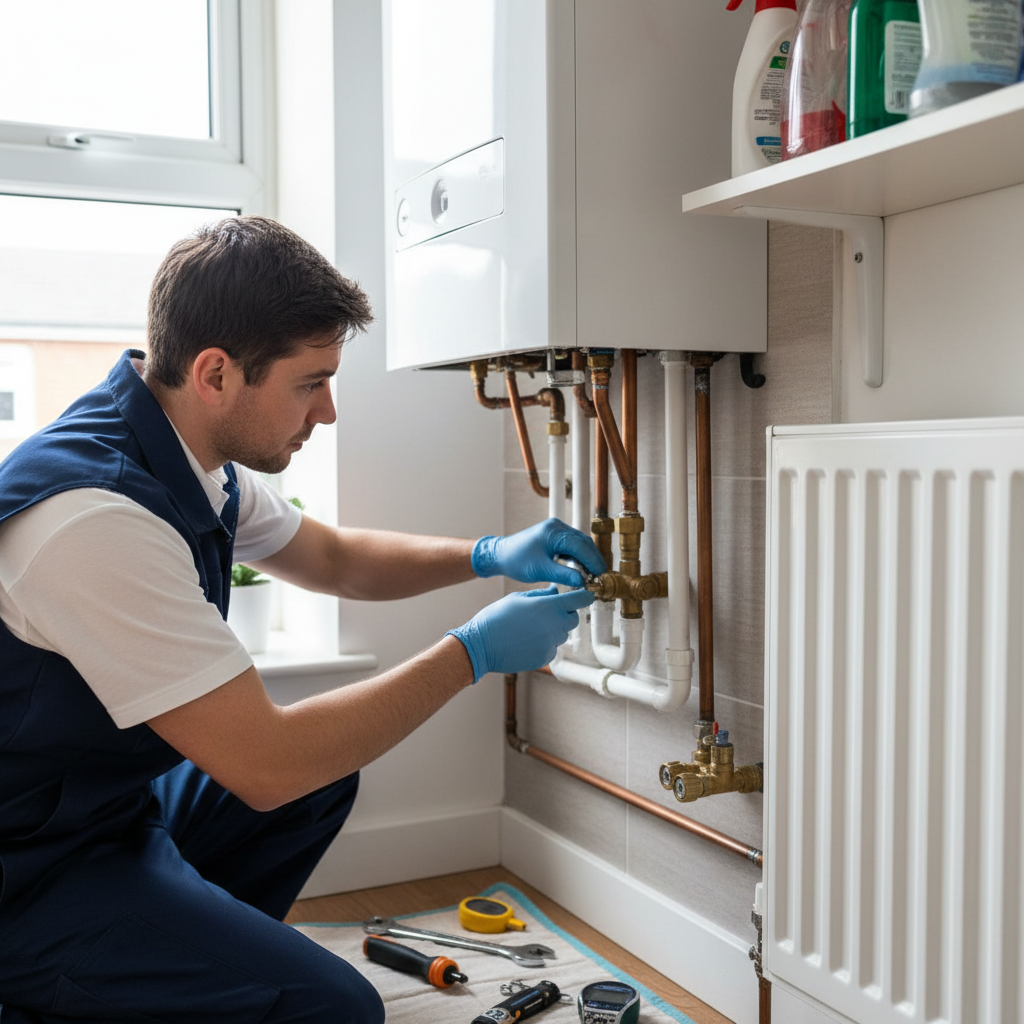
Boiler pressure that keeps falling usually means something is wrong. Learn the likely causes, safe top-up steps, and when to call an engineer.
Why Your Boiler Pressure Keeps Dropping in the UK
If your boiler pressure keeps dropping, it is easy to treat it as a small annoyance and simply top it up again. In reality, repeated pressure loss usually points to a fault somewhere in the heating system.
The good news is that some causes are straightforward to spot. The key is knowing what is normal, what you can safely do yourself, and when it is time to call in a professional.
What Boiler Pressure Should Be
Most modern combi and system boilers in UK homes run best at around 1.0 to 1.5 bar when the system is cold. When the heating is on, the pressure will usually rise a little.
A small increase is normal. Many boilers will sit somewhere between 1.5 and 2.0 bar when hot, although the exact range depends on the model.
How to read the pressure gauge
Your boiler may have a digital display or a round analogue gauge. Either way, the pressure is usually shown in bar.
If the reading drops below about 1 bar, the boiler may stop working properly or lock out completely. Some models will also show a warning or fault code when pressure is too low.
- Pressure below 1 bar is usually too low
- A reading around 1.2 bar when cold is often ideal
- A slight rise during heating is normal
- Pressure near 3 bar can signal overpressurising
If you are unsure what is normal for your boiler, check the label near the gauge or the user instructions. Different brands can have slightly different target ranges.
One low-pressure event after bleeding radiators is not usually a major concern. Pressure that keeps falling every few days is different and needs attention.
Common Reasons Boiler Pressure Keeps Dropping
In a sealed heating system, pressure should stay fairly stable. If it does not, water is usually escaping somewhere or the boiler is releasing it through a faulty component.
That is why repeated topping up is not a long-term answer. It hides the symptom without fixing the cause.
Small leaks in the heating system
The most common cause is a small water leak. This could be from a radiator valve, a pipe joint, a towel rail, or a connection beneath the boiler.
Some leaks are hard to notice because the water evaporates on hot pipework. You may only see a faint stain, greenish residue, or damage on flooring or skirting boards.
Radiators have been bled recently
Bleeding radiators removes trapped air, but it also lets out a little system pressure. Afterward, it is normal to need one careful top-up using the filling loop.
What is not normal is having to repressurise again and again after that. If pressure keeps dropping, there is likely another issue in the system.
Expansion vessel or pressure relief valve faults
The boiler’s expansion vessel helps absorb the extra volume created when water heats up. If it loses its air charge or fails, pressure can swing sharply as the boiler runs.
That can trigger the pressure relief valve to discharge water outside through a copper pipe. Once that happens a few times, the system pressure may keep falling back down.
Places to check for visible signs
You do not need to dismantle anything to do a basic visual inspection. Focus on easy-to-reach parts of the system first.
Look slowly and carefully, especially around joints and valves. Even a tiny drip can cause a noticeable pressure drop over time.
- Radiator valves and lockshield caps
- Pipe joints under sinks or in airing cupboards
- The area beneath the boiler casing
- The outside pressure relief pipe for drips
If you find a visible leak, avoid using the boiler more than necessary until it is checked. Persistent water loss can cause corrosion and damage over time.
If you cannot see a leak, the fault may still be internal to the boiler or hidden in pipework. That is where proper testing becomes important.
How to Repressurise a Boiler Safely
If the pressure has dropped once and there is no obvious leak, you can usually top it up using the filling loop. This is a standard homeowner task on many boilers.
The important thing is to do it slowly. Adding water too quickly or too far can push the pressure too high and create another problem.
Boiler controls vary, so stop if the valves or hose do not match what you expect. If in doubt, do not force anything.
- Turn the heating off and let the boiler cool
- Locate the filling loop or filling key
- Open the valves slowly to let water in
- Watch the gauge as the pressure rises
- Stop at around 1.2 to 1.5 bar when cold
- Close both valves fully and remove the key if fitted
Once the pressure is back in range, switch the boiler on and check whether it resets normally. Some models need a manual reset button after low pressure.
If the pressure drops again within hours or days, stop topping it up repeatedly. Fresh water introduces oxygen into the system, which can increase internal corrosion over time.
When Low Pressure Means You Need an Engineer
Some pressure issues are simple and harmless. Others point to worn boiler parts, internal leaks, or faults that should only be handled by a qualified engineer.
Never remove the boiler casing or attempt internal repairs yourself. Gas appliances must be worked on safely and correctly.
Warning signs to take seriously
Repeated pressure loss is the clearest red flag. It tells you the system is not staying sealed as it should.
Other symptoms can help narrow down the cause. Pay attention to changes in performance as well as the gauge reading.
- The boiler needs topping up every week
- You hear kettling or banging noises
- Radiators keep getting cold at the top
- There is water dripping from an outside copper pipe
- The boiler shows recurring pressure-related fault codes
- Pressure rises fast when heating is on, then falls when off
These signs often point to problems such as a failed expansion vessel, a faulty pressure relief valve, or a hidden leak. None of those faults improves on its own.
The longer the issue continues, the more stress it can put on pumps, valves, and heat exchangers. Early diagnosis is usually the most cost-effective route.
How to Prevent Boiler Pressure Problems
You cannot prevent every fault, but a few simple habits make pressure problems less likely. They also help you catch issues before they turn into a no-heat emergency.
Prevention is especially important before winter, when your boiler and radiators are under the most strain. Small faults tend to show up fastest during heavy use.
- Check the pressure gauge once a month
- Bleed radiators only when needed
- Top up pressure slowly and only to the correct range
- Look for damp patches around radiators and valves
- Book an annual boiler service
- Act quickly if pressure drops more than once
An annual service can spot early signs of wear in the expansion vessel, filling loop, or pressure relief valve. It also helps keep the boiler efficient and reliable.
For homeowners, the best rule is simple: one top-up may be normal, repeated top-ups are not. If the pressure keeps falling, there is usually a reason.
Need Professional Help?
If your boiler pressure keeps dropping, it is worth getting the system checked properly rather than repeatedly refilling it. That is the fastest way to find the real fault and avoid bigger repair costs later.
Net-Plumbers helps homeowners across London with boiler pressure problems, hidden leaks, faulty pressure relief valves, and expansion vessel issues. We aim to give clear, practical advice and safe repairs.
As a Gas Safe registered company (No: 217785), we carry out boiler and heating work to the correct safety standards. Call us on 0330 520 1642 or book online.
Need Help?
Got a plumbing or heating issue?
Gas Safe engineers available 24/7 across London. No call-out fee.