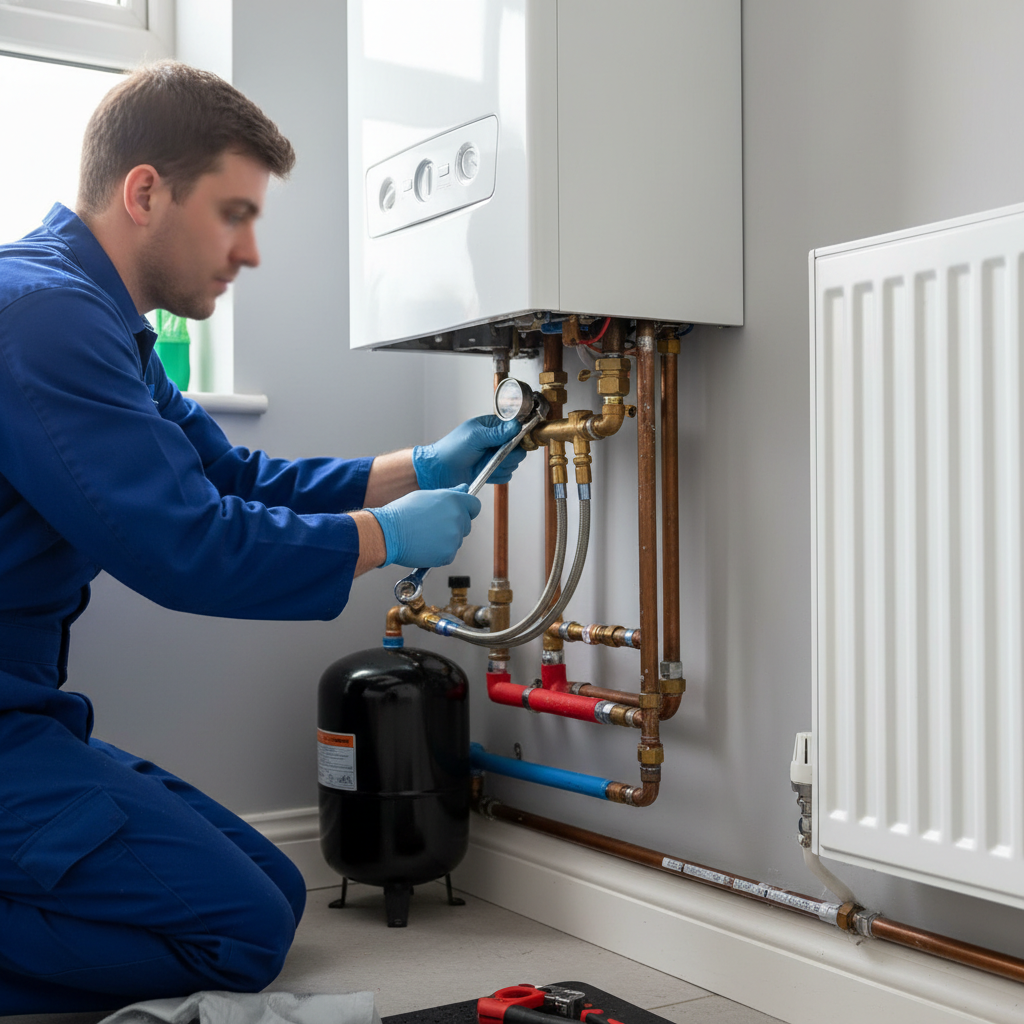
Boiler pressure falling overnight? Discover the real causes, safe checks you can do now, and when to call a Gas Safe engineer to protect your system and restore reliable heat.
Boiler Pressure Keeps Dropping Overnight: Causes & Safe Fixes
Waking up to a cold home and a boiler showing low pressure is frustrating and worrying. When boiler pressure keeps dropping overnight, it’s a sign something in the sealed system isn’t holding water or handling expansion correctly.
This guide explains the most common reasons, the safe checks you can do yourself, and the point at which you should bring in a Gas Safe engineer to prevent damage.
What “normal” boiler pressure looks like
On most domestic systems, a cold pressure around 1.0–1.5 bar is typical. When heating, it can rise to about 2.0 bar without concern.
If your gauge regularly falls below 1.0 bar, the boiler may lock out to protect itself. Persistent drops mean there’s a fault to resolve, not just a one-off top-up.
Why a sealed system loses pressure
Sealed systems rely on water-tight pipework, radiators, and components to keep pressure stable. Even a tiny leak can cause an overnight drop.
Expansion is absorbed by a vessel with an air charge. If that charge is low or the diaphragm fails, pressure swings up while hot and drops dramatically when cool.
Quick checks you can do safely today
Many causes are visible without opening the boiler case. You can often spot tell-tale drips or stains that confirm a slow loss.
Always allow the system to cool before touching pipework or radiators. Do not remove the boiler casing—this is for Gas Safe engineers only.
Simple observations around the home
Start with the pressure gauge and a slow, methodical walk-around. You’re looking for water marks and signs of discharge.
If the pressure rises when hot and sinks below 1.0 bar by morning, note the pattern. This helps diagnose expansion-related faults.
- Check the boiler’s pressure gauge cold and again when hot
- Inspect all visible pipe joints for fresh drips or green/white crust
- Look beneath radiators and at valve tails for damp patches
- Check ceilings below upstairs pipes for stains or blistering paint
- Go outside and examine the copper pressure relief discharge pipe end
- Confirm every radiator bleed valve is finger-tight (snug, not overtight)
Is the filling loop fully closed?
On many combi and system boilers, a flexible filling loop with two small valves is used to top up. If either valve is not fully closed, the system may creep higher when cold, then dump water via the safety valve.
Visually check each lever or screw-head is firmly shut in the “off” position. If unsure, do not force it—levers should align with the pipe when open and sit across the pipe when closed.
- Locate the filling loop under or near the boiler
- Verify both isolation valves are fully closed
- Check for any slow drip from the loop connections
- Remove the silver braided hose if the manufacturer allows when not in use
The most common causes of pressure loss
Once you have completed the basics, it helps to understand the typical culprits. Some are DIY-fixable; others need specialist tools and certification.
When in doubt, stop topping up. Constantly adding water accelerates corrosion and can mask the real problem.
Likely culprits explained
Each cause has distinctive symptoms. Matching those signs to your observations can save time and prevent unnecessary part swaps.
Use the list below to guide your next step, then decide whether it’s safe to proceed or time to call a pro.
- Weeping radiator valves or tails causing slow overnight drops
- Leaking automatic air vent (AAV) near the boiler leaving crusty deposits
- Pressure relief valve (PRV) passing water to the outside discharge pipe
- Failed or undercharged expansion vessel causing hot spikes and cold drops
- Hidden pipework leak under floors or in walls evidenced by stains or musty smells
- Filling loop left slightly open leading to over-pressurisation and dumping
- Corroded towel rail or pinhole radiator leaks leaving tiny rust marks
When pressure rises while heating, then crashes when cool
This pattern strongly suggests an expansion control issue. The expansion vessel contains a rubber diaphragm and an air charge that cushions water as it heats.
If the air side is flat or the diaphragm has failed, pressure can shoot towards 3.0 bar when hot, forcing the PRV to open. As the system cools, lost water leaves the gauge low by morning.
Tell-tale signs of PRV or vessel trouble
A steady drip from the outside copper discharge pipe indicates the PRV is passing. Once a PRV has lifted repeatedly, it may not reseal properly and can keep weeping.
An expansion vessel that “rings full” when tapped, or whose Schrader valve spurts water instead of air, is faulty and needs professional attention.
How to repressurise safely — and when to stop
Repressurising is straightforward on most combi and sealed systems. You are simply adding mains water via the filling loop until the cold gauge reads about 1.2 bar.
Only top up after the system is cool. Topping up frequently is a red flag. If pressure drops again within hours or daily, stop and arrange a diagnosis to avoid long-term damage.
Using a typical external filling loop
Make sure both filling loop valves are closed before you start. Keep an eye on the gauge at all times to avoid overshooting.
If unsure about your model’s procedure, check the user manual supplied with the boiler. Never remove panels secured by screws.
- Turn the boiler off and allow it to cool fully
- Attach the braided hose securely if it’s been removed
- Open one filling valve slightly, then crack open the second
- Watch the pressure rise slowly towards 1.2 bar
- Close both valves firmly as the needle approaches target
- Bleed a radiator if there’s trapped air, then top up again to 1.2 bar
- Turn the boiler back on and check for stable pressure
Important warnings before DIY work
Boilers contain gas components and safety devices that must not be tampered with. UK law requires a Gas Safe registered engineer for internal boiler work.
Water leaks can damage electrics. If you suspect water inside the boiler case or see evidence of arcing, isolate power and seek professional help immediately.
- Do not remove the boiler case or touch sealed gas components
- Stop topping up if pressure keeps falling more than once a week
- If the outside PRV pipe drips, book an engineer to test/replace it
- If the expansion vessel has lost charge, it needs recharging or replacement
- Persistent stains on ceilings or floors warrant leak tracing
- Brown sludge in bled water suggests corrosion and may need treatment
Need Professional Help?
If your boiler pressure keeps dropping overnight after basic checks and a careful top-up, it’s time for expert diagnosis. Net-Plumbers are Gas Safe registered (No: 217785) and experienced with all major UK boiler brands.
We can test PRVs, recharge or replace expansion vessels, trace hidden leaks, and get your heating stable again with minimal disruption. Call us on 0330 520 1642 or book online.
Need Help?
Got a plumbing or heating issue?
Gas Safe engineers available 24/7 across London. No call-out fee.